Peer Review Process
JOTTER: Journal of Teacher Training and Educational Research applies a rigorous, fair, and ethical peer-review process to ensure the quality, originality, validity, and relevance of published research.
All manuscripts submitted to JOTTER must comply with the journal’s Focus and Scope, Author Guidelines, Publication Ethics, and technical submission requirements. Manuscripts must be original, unpublished, and not under consideration by another journal.
JOTTER applies a double-blind peer-review process, meaning that the identities of authors and reviewers are kept anonymous throughout the review process. Authors must remove identifying information from the manuscript file, including author names, affiliations, acknowledgements, and self-identifying references where necessary. Author information must be submitted separately through the journal submission system.
1. Initial Evaluation
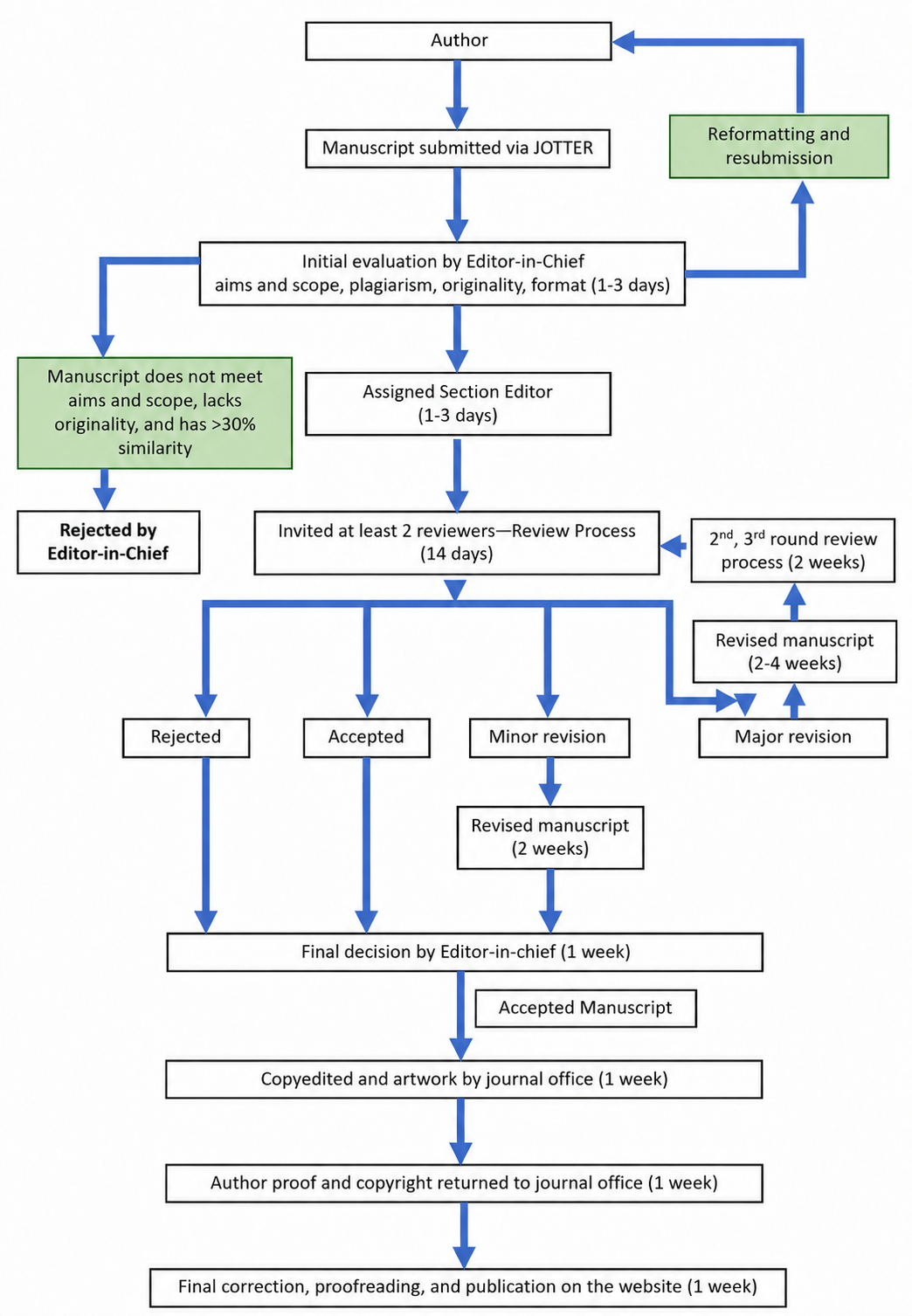
Upon receipt of a manuscript, the Editorial Office and Editor-in-Chief conduct an initial evaluation to assess:
- suitability with the journal’s aims and scope;
- compliance with Author Guidelines and manuscript format;
- originality and similarity level;
- completeness of submission files;
- ethical compliance and required declarations;
- quality of language, references, and citation style.
Manuscripts that are outside the journal’s scope, do not meet minimum academic standards, contain serious formatting problems, or show a similarity index above 25% will be returned to the author for correction and resubmission. Where a manuscript is potentially suitable but does not meet formatting, citation, or technical requirements, it may be returned to the author for reformatting and resubmission before further editorial processing.
2. Assignment of Editor and Reviewers
Manuscripts that pass the initial evaluation are assigned to a Section Editor or Handling Editor.
The assigned editor will invite at least two independent reviewers with expertise relevant to the manuscript’s field of study. Reviewers are selected based on their academic qualifications, research experience, subject expertise, and ability to provide constructive and objective feedback.
Reviewers should not have a personal, professional, institutional, financial, supervisory, collaborative, or competitive relationship with the author(s) or their institutions. Where possible, invited reviewers should be affiliated with institutions different from those of the corresponding author.
Where reviewer reports substantially differ, the editor may invite an additional reviewer or seek advice from another qualified editor or expert.
3. Review Process
Reviewers evaluate manuscripts based on:
- originality and contribution to knowledge;
- relevance to teacher education, educational research, or related fields;
- clarity of research objectives and research questions;
- methodological soundness;
- accuracy and validity of analysis and findings;
- quality of discussion and conclusions;
- relevance and appropriateness of references;
- ethical compliance;
- clarity of writing, organization, and presentation.
Reviewers are expected to provide constructive, respectful, evidence-based, and confidential comments. They may recommend one of the following decisions:
- Accept;
- Minor Revision;
- Major Revision;
- Reject.
Reviewers are normally expected to complete their evaluation within two weeks, subject to reviewer availability.
4. Editorial Decision
The Editor-in-Chief makes the final editorial decision based on reviewer comments, the recommendation of the assigned editor, the manuscript’s quality, and compliance with JOTTER policies.
The possible editorial decisions are:
- Reject;
- Accept;
- Minor Revision;
- Major Revision.
Reviewer comments and editorial decisions are communicated to the corresponding author through the online submission system. Reviewer identities remain confidential in accordance with the double-blind peer-review policy.
A request for revision does not guarantee acceptance of a manuscript.
5. Revision Process
Authors receiving a revision decision must revise the manuscript in response to reviewer and editor comments.
The revised submission should include:
- a clean revised manuscript;
- a manuscript with highlighted or tracked changes, where requested;
- a point-by-point response letter explaining how each reviewer comment has been addressed.
Authors are normally given:
- two weeks for minor revisions;
- four weeks for major revisions.
Minor revisions may be evaluated directly by the assigned editor. Major revisions may be returned to the original reviewers or sent to additional reviewers for another round of review.
6. Final Decision and Production
After the revised manuscript has been evaluated, the Editor-in-Chief makes the final decision.
Once accepted, the manuscript proceeds to copyediting, layout editing, author proof review, final correction, and publication.
Authors may be asked to review proofs and return corrections within the deadline set by the editorial office. Corrections at this stage should be limited to typographical, factual, or production errors.
Publication Ethics and Publication Malpractice Statement for Peer Review Process
JOTTER is committed to upholding the highest standards of publication ethics and preventing publication malpractice throughout the peer-review process. The journal applies the following principles.
1. Confidentiality
The peer-review process is confidential. Editors, reviewers, and editorial staff must treat all submitted manuscripts, reviewer comments, author responses, and related editorial information as confidential documents.
They must not disclose, copy, distribute, discuss, or use unpublished material for personal benefit without authorization from the Editor-in-Chief.
Reviewers must not upload manuscripts, reviewer comments, or confidential research data to public AI tools or unauthorized third-party platforms.
2. Objectivity and Impartiality
Peer review must be conducted objectively, fairly, and without discrimination. Editors and reviewers must evaluate manuscripts based on academic merit, originality, methodological soundness, ethical compliance, relevance, and quality.
Reviewers should provide clear, respectful, evidence-based, and constructive feedback. Personal criticism, discriminatory language, unsupported opinions, and biased comments are not acceptable.
3. Timeliness
JOTTER is committed to timely editorial handling and peer review. Reviewers are normally expected to complete their review within two weeks, subject to reviewer availability.
Authors will be informed of major updates or decisions concerning their manuscript through the journal submission system. Delays may occur in exceptional circumstances, including difficulty obtaining qualified reviewers or the need for additional review.
4. Transparency and Accountability
Editors should make fair and well-informed decisions based on reviewer comments, editorial assessment, journal policies, and academic judgment.
Reviewers are expected to provide clear reasons for their recommendations. Editorial decisions and reviewer comments will be communicated to authors anonymously in accordance with the double-blind peer-review policy.
5. Conflict of Interest
Editors and reviewers must declare and avoid any personal, professional, institutional, financial, supervisory, collaborative, or competitive conflict of interest that may affect their impartiality.
Where a conflict of interest exists, the editor or reviewer must withdraw from handling or reviewing the manuscript. The manuscript will be assigned to another qualified editor or reviewer without a relevant conflict of interest.
6. Plagiarism and Research Misconduct
Editors and reviewers should remain alert to potential plagiarism, self-plagiarism, duplicate publication, data fabrication, data falsification, citation manipulation, peer-review manipulation, false ethical approval claims, undisclosed conflicts of interest, or other forms of research misconduct.
Any suspected misconduct must be reported promptly to the Editor-in-Chief for appropriate assessment and follow-up.
7. Peer Reviewer Recognition
JOTTER recognizes the important contribution of peer reviewers in maintaining the quality, integrity, and credibility of the journal.
The journal may provide appropriate acknowledgement or recognition to reviewers for their contribution, while maintaining the confidentiality required by the double-blind peer-review process.